
Soul Tracking - Reflections from our Founders Rite of Passage Retreat in South Africa
What Founders are Really Tracking
It doesn’t get much wilder than tracking lions on foot. However, I’ve noticed that many founders experience more fear, intensity, and loneliness in the day-to-day of the modern business world than they do in the wild. In the South African bush, the cliché of being chased by a lion or tiger, which we often use as a metaphor for the fight-or-flight response we constantly experience as founders, is no longer proverbial.
Two weeks ago, we took nine courageous founders and executive leaders into the South African savanna of Kruger National Park to track lions and rhinos, while also delving into introspective coaching. It’s a special transformational program we’ve named Soul Tracking.
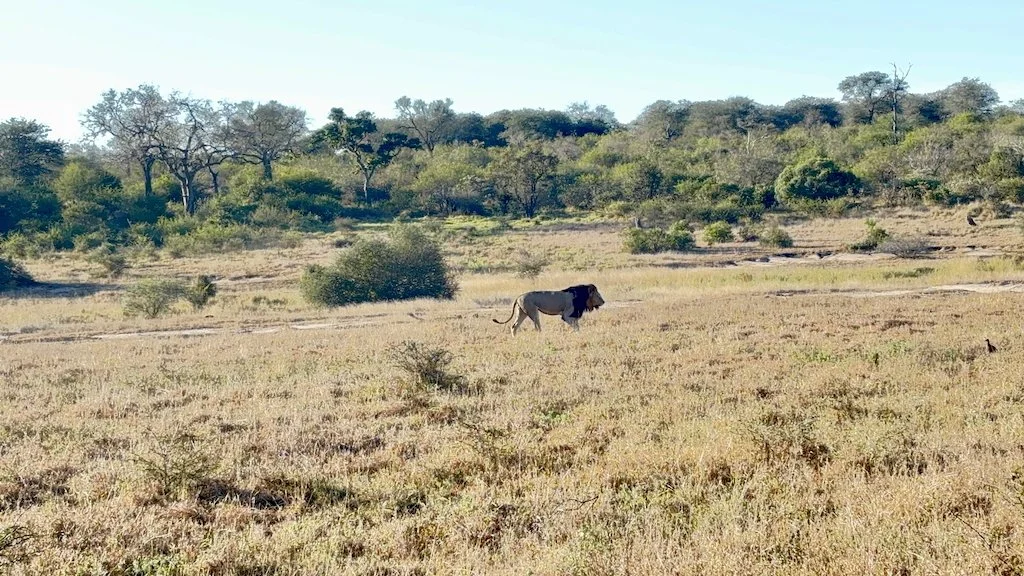
Solo lion on the hunt, Kruger Park, June 2026. Photo by Justin Perkins.
Many founders I encounter in my coaching practice are looking for something deeper than another management hack or piece of advice. As founders, it’s easy to lose touch with our humanity beneath our roles. Our core identity, or soul, can be obscured by insecurity, over-responsibility, and the relentless pressure we’ve signed up for as part of the game of entrepreneurship.
So, my fellow founder coach, Yanush Cherkis, and I developed the Founders Oasis as a series of rites-of-passage programs in nature to help founders reconnect with themselves and develop a sense of community with a global web of extraordinary leaders who have shared this rare experience.
Why do we go animal tracking? Tracking animals is arguably the oldest human art form. And through relearning the tracking process, we’ve discovered many lessons and metaphors applicable to being a founder and leader, while also connecting us back to our native instincts of curiosity, deep listening, equanimity, attunement, and relaxation into a connected flow state.
This is a visceral way for entrepreneurs to experience a framework I developed for founders called CLEAR LeverageTM. I have people draw each of the five letters on the fingertips of one hand and then practice each of the five skills—Curiosity, Listening, Equanimity, Attunement, Relaxation—while tracking in the bush or listening in a coaching circle. Each finger represents a lever that can be pulled to get back on track or self-regulate when you’re off center internally or find yourself in conflict with others. Developing facility with this combination of native skills can be a powerful and practical way to self-regulate under pressure.
Soul Tracking is not a conventional driving safari designed to see the “Big Five” African animals. We walk deep into the bush, and then debrief through a facilitated coaching conversation that leverages insights from the tracking experience and helps people shed outgrown identities. We learn just as much when we don’t find any animals, though we usually do. A key aspect of the Soul Tracking program is our partnership with three masterful, native South African animal trackers, dedicated to conservation and preserving the skill of tracking for future generations: Renias, Alex, and the lead instructor of their tracking school, named Innocent.
Alex and Renias provide us with rare access to places very few humans are allowed to go as we track animals on foot in the bush at their seasonal camp, Kruger Untamed. Through this combined experience of tracking and coaching, it’s incredible to watch the founders we bring both slow down and experience more of themselves without the social comparisons and need to perform.
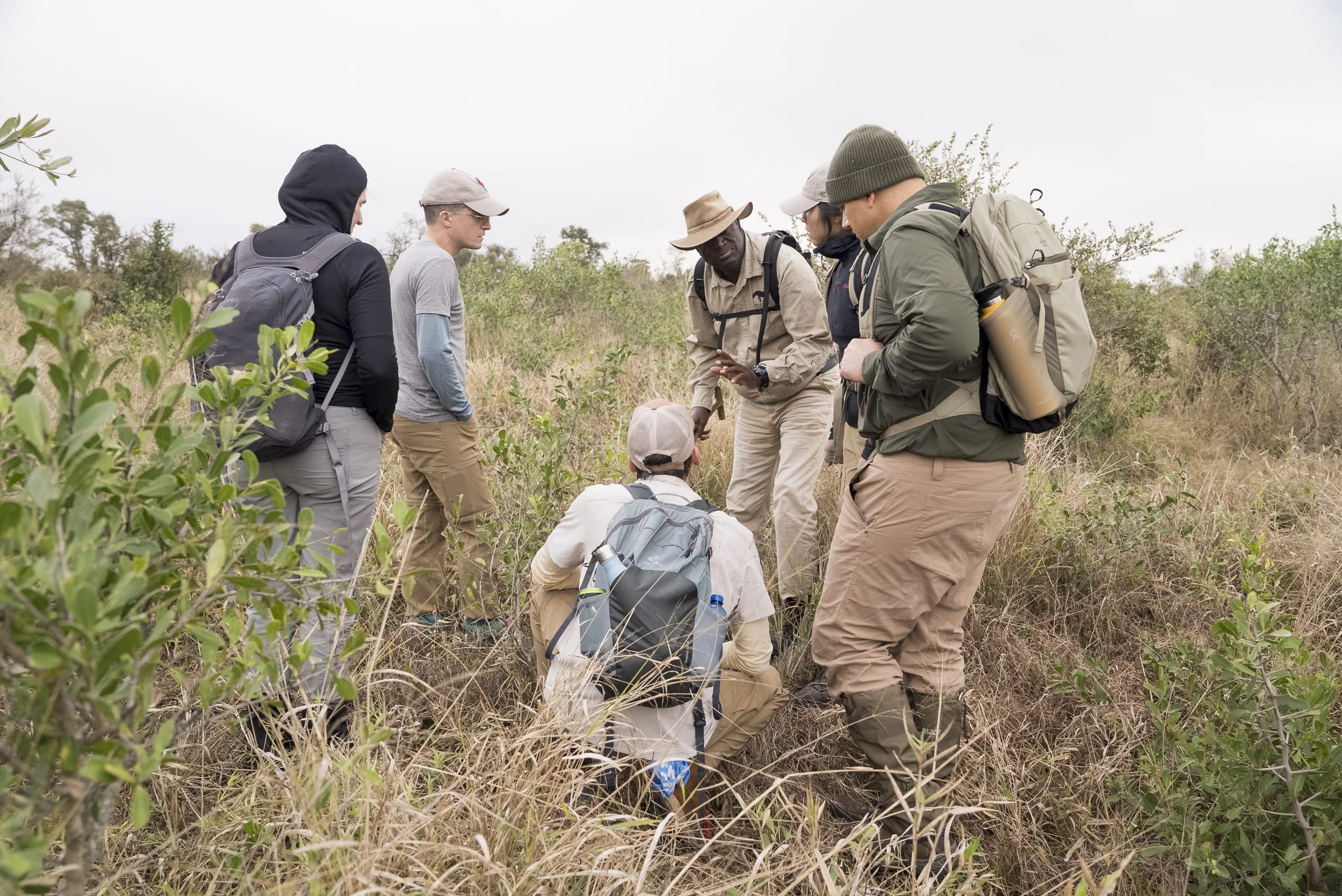
Tracking with Renias. Photo by James Tyrrell
Unplugging And Reconnecting
A normal morning in our program begins before sunrise. It’s cold, dark, and extremely quiet at 5:00 a.m. in the savannah during the African winter. Vivid dreams are interrupted by the friendly, lilting voice of one of our guides gently calling you to wake up. It’s a welcome sound after a night of solitude and rest. Tucked into a warm safari tent, it can take a moment to remember that you’re in the middle of one of the wildest places on the planet. If you’re lucky, you’ve heard a lion roar or a leopard call nearby in the wee hours.
We gather for coffee in a beautiful, oasis-like communal tent at the center of camp. The camp is perched on a riverbank, surrounded by thick bush and tall trees, overlooking a dry, sandy riverbed. This rare, eco-friendly camp, called Kruger Untamed, exists for only five months each year. It is assembled piece by piece in May and completely dismantled by the end of September, allowing the ecosystem to recover from the human impact.
We settle into a circle around the fire, waiting for first light, and enjoying the silence and company as we shake off the sleepiness. When the coffee is finished, we climb into two open-air Land Rovers and drive into the dawn as the bush begins to fill with light.
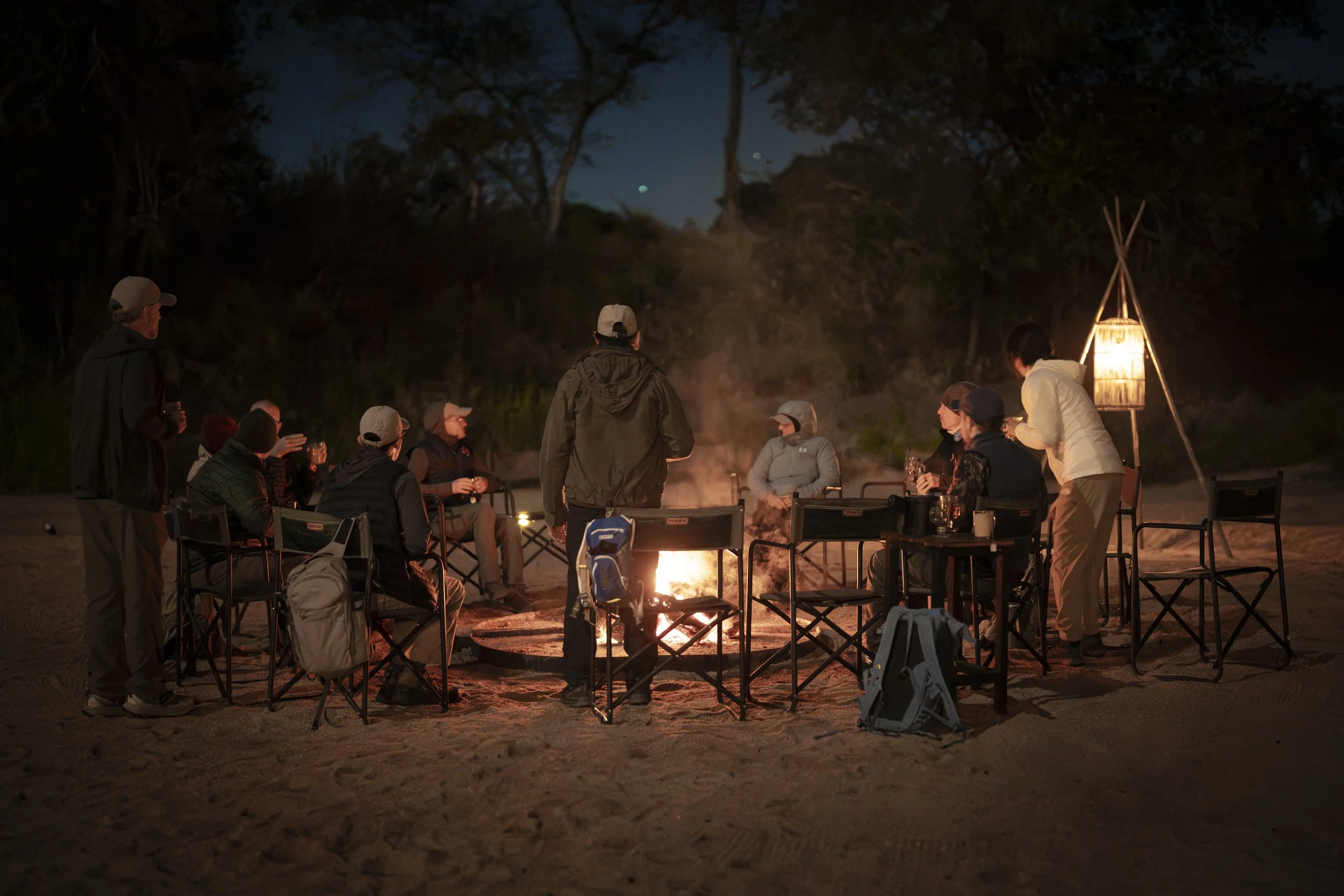
Photo by James Tyrrell
As a daily ritual, we stop by a whale-sized rock formation overlooking the riverbed and sit together to meditate, watch the sunrise, and listen to the birds coming awake. Once in a while, the cacophony of interplaying birdsongs is disrupted by a lion's distant roar or a hyena's laugh. Immersed in this nature sound bath, it’s impossible not to feel awe and gratitude for the land and sync back up to a deeper, ancient rhythm that our bodies recognize instinctively.
The substrate of silence without constant mechanical noise is mesmerizing. And if you’ve never seen an African sunrise or sunset, the colors can be otherworldly purples, pinks and oranges. It’s rare to be in a place with such vast views, where you can often see the entire horizon in all directions. In the open Savannah, it feels as if you can even see the curvature of the earth, much like you can out at sea.
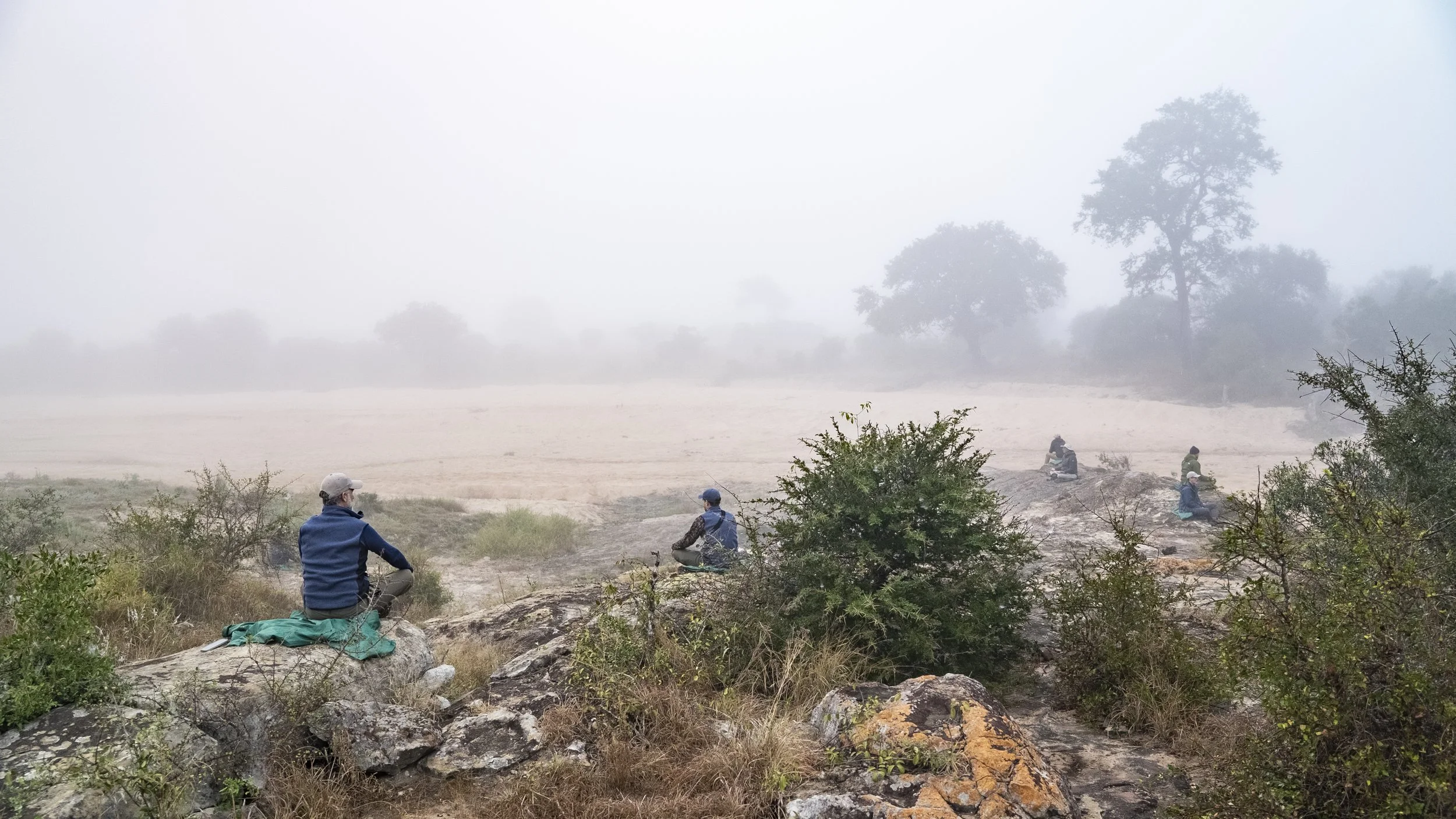
Every day could start like this. Photo by James Tyrrell.
When The Track Disappears
As the sun comes above the horizon, the group becomes restless to move. We climb back into the vehicles in search of fresh animal tracks, trusting that Alex, Renias, and their team will lead us on a memorable escapade and likely find animals.
So far we have been quite lucky, and with them, we’ve almost always encountered an animal at the end of the trail, or at least gotten close. But we’ve worked with them enough to know that just being around them, we can’t lose. Even if we run out of time or lose the animal tracks, Renias will often drop into a masterclass on the local plants or share a funny parable or joke from the wisdom of his indigenous Shangaan culture. Or we’ll learn lessons in partnership and leadership by observing the two of them work in concert, the result of intuitive communication forged over thirty years of shared experience.
Their unusual partnership bridges all kinds of unexpected barriers across time, economic diversity, and the cultural divides of South Africa's apartheid era. Their story is detailed by Alex in his inspiring book, Changing a Leopard’s Spots. Renias and Alex are mentors and mates of best-selling author Boyd Varty, and are also the main characters in his book, The Lion Tracker's Guide to Life, which drew us to Africa in the first place. One of the most often quoted lines from the book is a playful bit of wisdom from Renias:
“I don’t know where I’m going, but I know how to get there.”
Over the course of the week, we enjoyed an abundance of animal encounters. To name a few, we saw ostriches racing our vehicle in twilight, spotted a cheetah in the early morning mist, watched as a formidable male lion strutted ahead of us down the road, stared at a rare pack of wild dogs that ran right past our vehicle, encountered a honey badger about twenty meters away while on foot, and glimpsed the exceptionally rare sight of a white rhino with a young calf. But perhaps the most memorable moment came when Renias lost the trail while tracking lions.
Renias is an encyclopedia of animal behavior, and he observes every detail. For example, he sometimes estimates the age of a lion track by noticing a single drop of dew on a blade of grass protruding from the track, which means the track is from last night, and the lion is likely long gone. Or he will notice a single hair from a lion’s mane caught on a particular type of bush they use for marking their territory.
Four kilometers into the tracking walk, all visible signs of the trail disappeared. The unusually heavy summer rains had left the winter grass much thicker and taller than normal, so there were few visible footprints. But this is where Renias is most remarkable. He does not rely on tracks alone, and he has learned to intuit where the animals would go. He reads the contours of the land, the temperature, the wind, the available shade, the behavior of other species in the area, and the routes lions are likely to choose. This is the result of decades of inquiry and constant curiosity. He holds an unfathomable amount of data in his mind and body. To this day, in the course of normal conversation, Renias is continuously asking, “Why does this happen? Why might a tree do this? Why is the angle of this track different? How does this system work?”
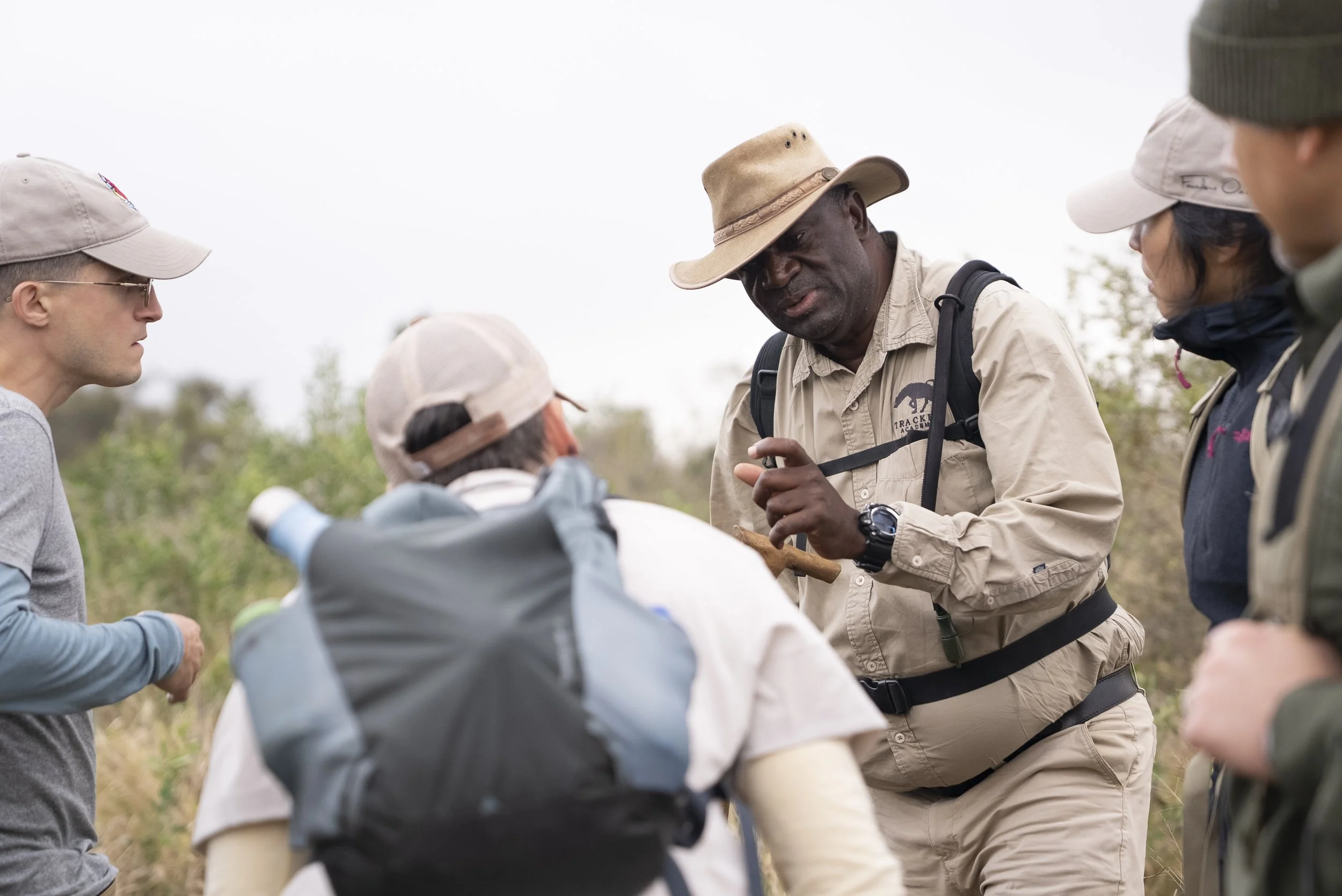
Tracking lions with Renias. Photo by James Tyrrell
When the immediate evidence runs out, he widens his attention. The other experienced guides on this trek were skeptical of the direction he chose. But those who have tracked with Renias have learned to trust his instincts even when the evidence is not obvious. As the group rounded a low ridge, they came upon a pride of lionesses and their cubs lying in the grass, and Renias was right yet again. It’s one thing to see this from the perceived safety of a vehicle. It’s quite another to be exposed on the ground, on their turf, hoping that the wind doesn’t change direction and they discover you.
The best trackers do not merely stare harder at the ground. They move between detail and context. When the visible track disappears, they widen their attention. As founders, we notoriously tend to do the opposite. Under pressure, attention often narrows. The mind speeds up, the system floods with anxiety, and focus fixates on the immediate track: the missed target, the difficult hire, the investor update, the unresolved conflict. The harder the problem feels, the more intensely we analyze, stare at it, or jump into reactive action.
But some problems cannot be solved by staring harder at the same patch of ground. Sometimes the leader needs to step back far enough to view the whole landscape—including the inner landscape from which every decision is being made.
Crossing The Threshold
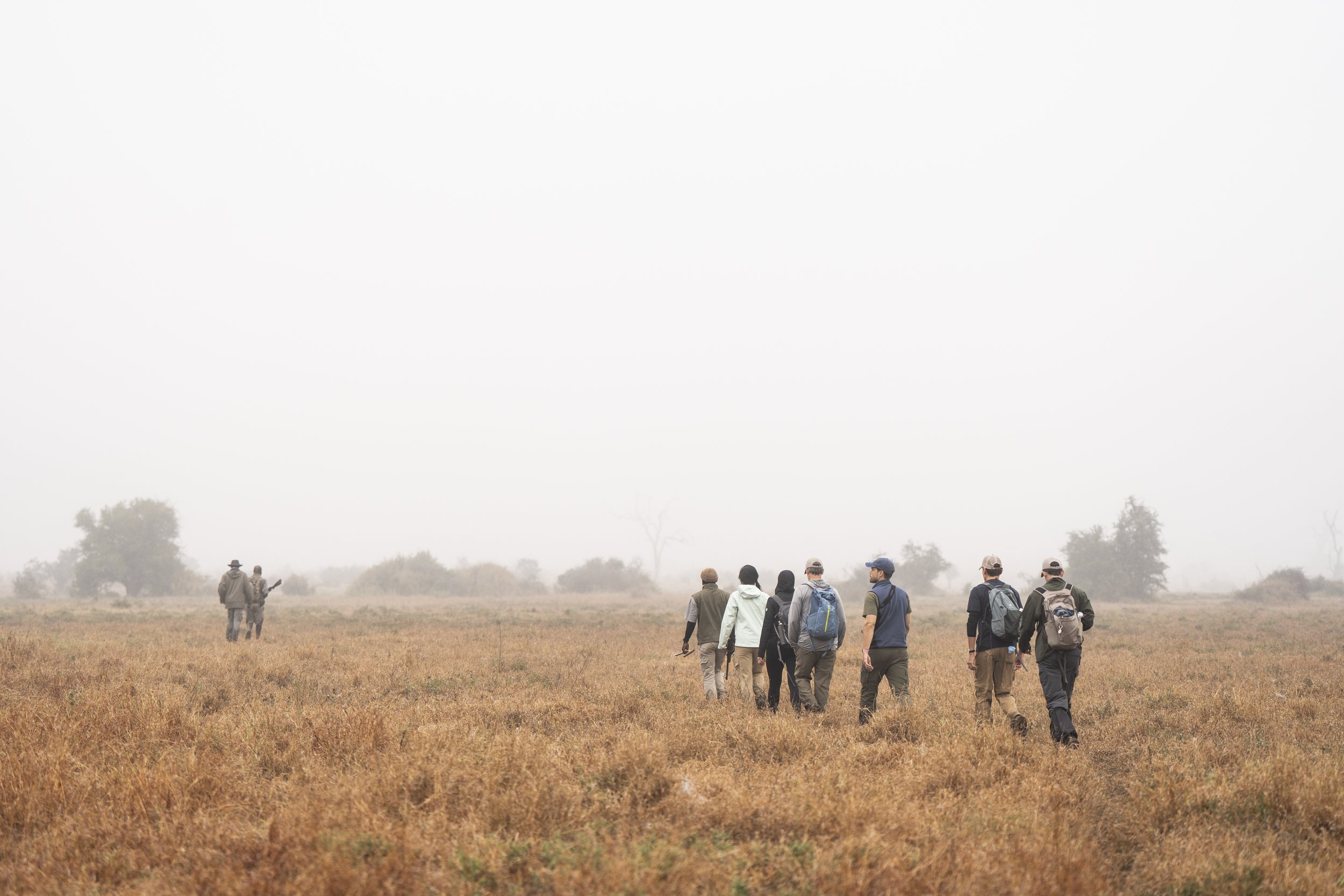
Walking into the unknown. Photo by James Tyrrell
The first threshold in this rite of passage began months earlier, when the attendees decided to step away from the machinery of their lives and devote their time, money, and attention towards a transformational experience on the other side of the planet. Simply carving out a week for themselves can feel indulgent. It can also sound a little crazy to tell your partner and friends that you’re going to go track lions in the bush. It will take some planning and preparation to make sure things don’t fall apart when you’re off the grid for a while.
If that gives you chills—it should. It’s a big ask, and as you might imagine, it requires an extraordinary person to clear those hurdles. The growth gained in the process of committing can be just as valuable as the trip itself. It can take two years for some to make it happen—and others are all-in and fully committed the moment they learn about the program, knowing intuitively they must go.
When we first arrive in Africa, we cross the second threshold from our familiar systems and into a realm we cannot control. Some of us crave the intense growth that this uncertainty inevitably spawns when we seek it. But we arrive, carrying the pace and momentum of our busy lives, and the contrast with the wilderness is immediately visible. Our minds are moving very quickly in modern life. Our nervous systems are accustomed to intensity and consistent stimulation. Some people arrive with last-minute loops to close and are still wondering about the email they missed, the contract awaiting approval, or what is happening on Slack. Then the visceral rhythms of the wilderness begin to place all of those self-created urgencies into perspective. Nature couldn’t care less about your next deal.
The founder's journey is an intense game. Beneath the individual circumstances of the founders we coach, we encounter some combination of chronic stress, anxiety, difficulty trusting others, and a loneliness that rarely gets acknowledged. Most founders are constantly surrounded by people who want something from them, so it often takes a while to relax and trust strangers. It is easy to become fused with the outcomes—to confuse the company, the mission, or the role with who you actually are. Nature has a way of loosening that attachment faster than almost anything else. But letting your guard down and going through a process like this doesn’t come at the expense of the business. On the contrary, we have seen that learning to let go of attachment to outcomes can restore the founder’s capacity to lead more effectively from their core, rather than running on the fumes of nonstop stress that drive constant reactivity, victimhood, and worry.
Coming from diverse contexts around the world, each person’s initial response to the bush is unpredictable. Some physically crash and need to sleep as much as possible, as their overstimulated nervous system finally feels safe enough to relax. Others become restless or irritated without their familiar habits and structures. Some come alive almost immediately and find themselves extremely present and energized.
Then, slowly, the deeper process of transformation begins as we settle into the rhythm of the bush and sync back up with the natural rhythm that our bodies seem to know when we spend enough time back in the wild. The group coaching gently helps to make sense of it all and stay grounded. It’s a regenerative experience, and you can feel as though parts of you that had receded start reclaiming their place.
Returning To Ourselves
By the second or third day, something palpable in the group's energy begins to soften. We start to show up without much cultural baggage or our habituated personas in the way. It’s like getting to meet people as they were when they were children, before we started developing personal strategies to fit in.
Attention shifts away from the technological landscape and the familiar loops of daily life back home. The body begins to adjust to the interplay of sunlight, movement, darkness, silence, and sleep. You can see people finally starting to relax.
In the modern race toward accomplishment—and amid the amplified intensity of running a complex business—it is easy to lose perspective and begin accepting chronic stress as normal. I paid a high price as an entrepreneur for redlining my system for over a decade straight, and it’s important for me to have other founders experience firsthand how good it feels and how productive it can be to prioritize their own wellbeing as the foundation of their company.
Against the backdrop of nature, outside of the complex noise of our familiar patterns, we can start to see the nuanced variability of our own minds more clearly. We can see our moods come and go more visibly as our thoughts change and energy levels shift. We can stop attributing stress to circumstances and see that it’s a reflection of the quality of our thinking at any moment. When we get fixated on a problem, just like when we get too focused on a track, our emotions follow. And when we zoom out and see the broader frame, we tend to loosen up, feel better, think more divergently, and see more opportunities. It’s my hope for these programs that people go home seeing more clearly how anxiety is just a function of the unconscious prevailing belief that you’re broken or a victim of circumstances. I want people to notice that every emotion, positive or negative, is just a function of how you focus your awareness. Your emotions are a dashboard of the quality of your thinking, presence, and internal alignment from moment to moment.
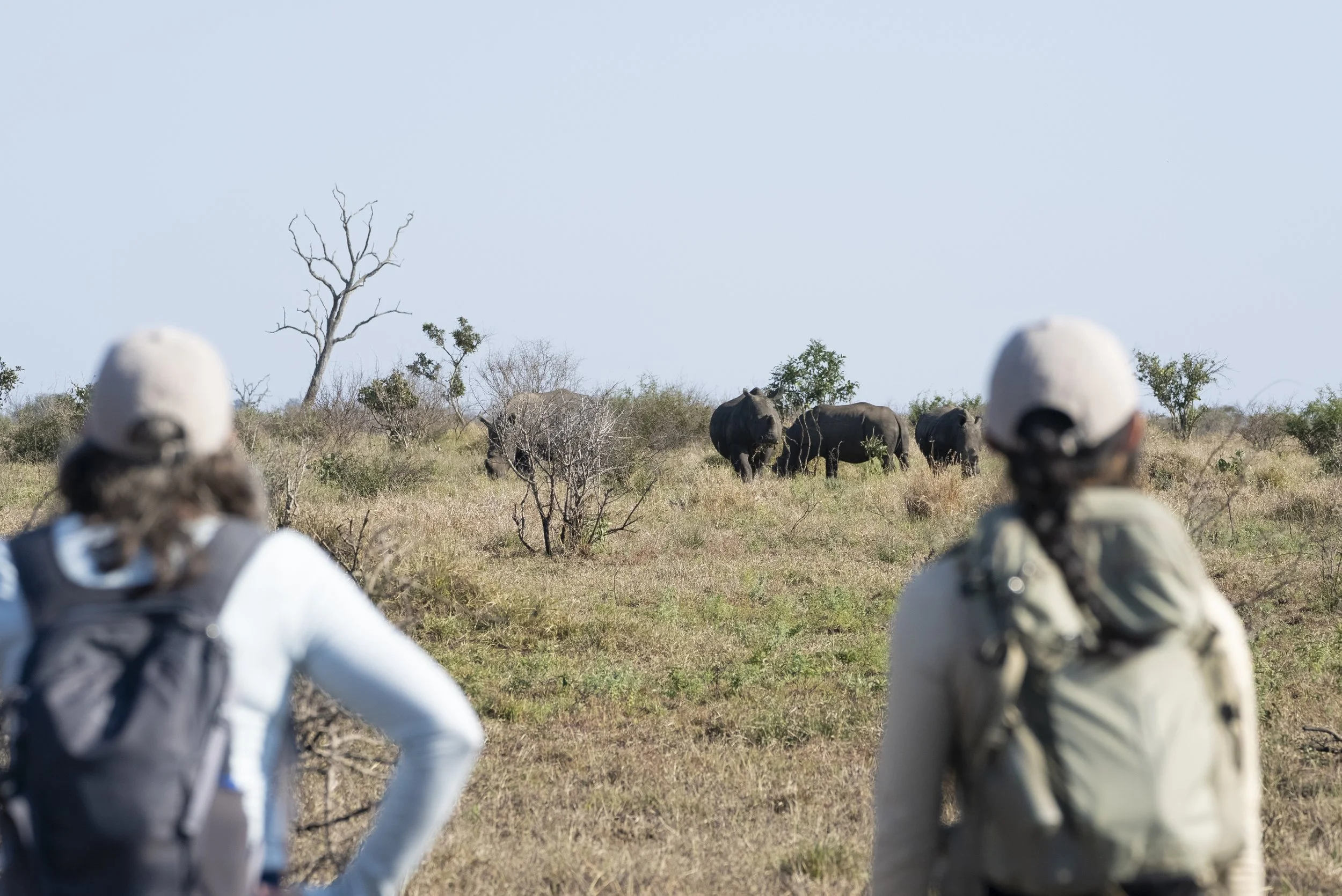
Rare rhinos. Photo by James Tyrrell.
By shifting your awareness away from your thinking and into your sensory experience of what’s happening around you, anxiety can immediately drop. It helps to know that your emotions follow your thinking and can trigger a feedback loop. You feel your thinking. This is not just a nifty trick or technique—it's learning how your human operating system works. Without the noise of our familiar surroundings, it’s easier to see and experience these dynamics when we are in the bush.
In addition to the internal reconnection that happens during these Soul Tracking experiences, we also experience what it’s like to live in small bands for a while, just as our hunter-gatherer ancestors did. Our species evolved in small tribes, and by moving together in interdependent groups in the bush, we remember the experience of our natural evolution. Our bodies quickly respond to the safety of being together in a group, sharing fire, food, stories, and collective purpose in our natural habitat. In the stunning book The Bushmen Winter Has Come, anthropologist Paul John Myburgh shares his story of living for seven years with the last wild Bushmen in the Kalahari, and he concludes, “We were all first peoples.“ The memory of these ancient ancestors is still buried in our DNA, and it seems to come alive when we’re back in our ancestral habitat. We did not evolve to be isolated and stuck in front of dopamine machines. And as we walk and talk together from an attuned state, the modern armor and structure that sustain a false sense of control and safety quickly drop away, and we rediscover how similar we all are at the core.
Each group develops its own rhythm, and the experience meets each person differently. Our job as guides is to create the container where people can see themselves in the mirror of nature, and invite them to gently explore beyond what they know, to stop hiding behind outgrown personas, and try some experiments that may be a bit new or uncomfortable, but are likely to reveal their deeper authentic way of being. In a way, what we are doing is gently inviting people to rewild themselves and to remember that uncertainty is the ideal sandbox for creativity. After all, that’s what drew them to entrepreneurship in the first place. Paradoxically, the payoff of rewilding is more intimate, more loving, and maybe even more “civilized” than what we experience back in the digitized world. Lives can often change direction through these experiences.
What returns home is not a permanent state of serenity, but it’s a baseline reset, a reminder for how rich life can be, and a taste of new possibilities as insights begin to percolate. Emails, contracts, family pressures, and difficult decisions are still waiting. But people often return with a little more space between themselves and the urgency—a clearer capacity to distinguish the true signal from the noise, and a recalibration toward nurturing more of what they want. Our hope is that they have remembered who they really are beneath the personas, and that their wild soul reintegrates and stays in charge at least a little more, and that the people they love get to experience them more accurately.
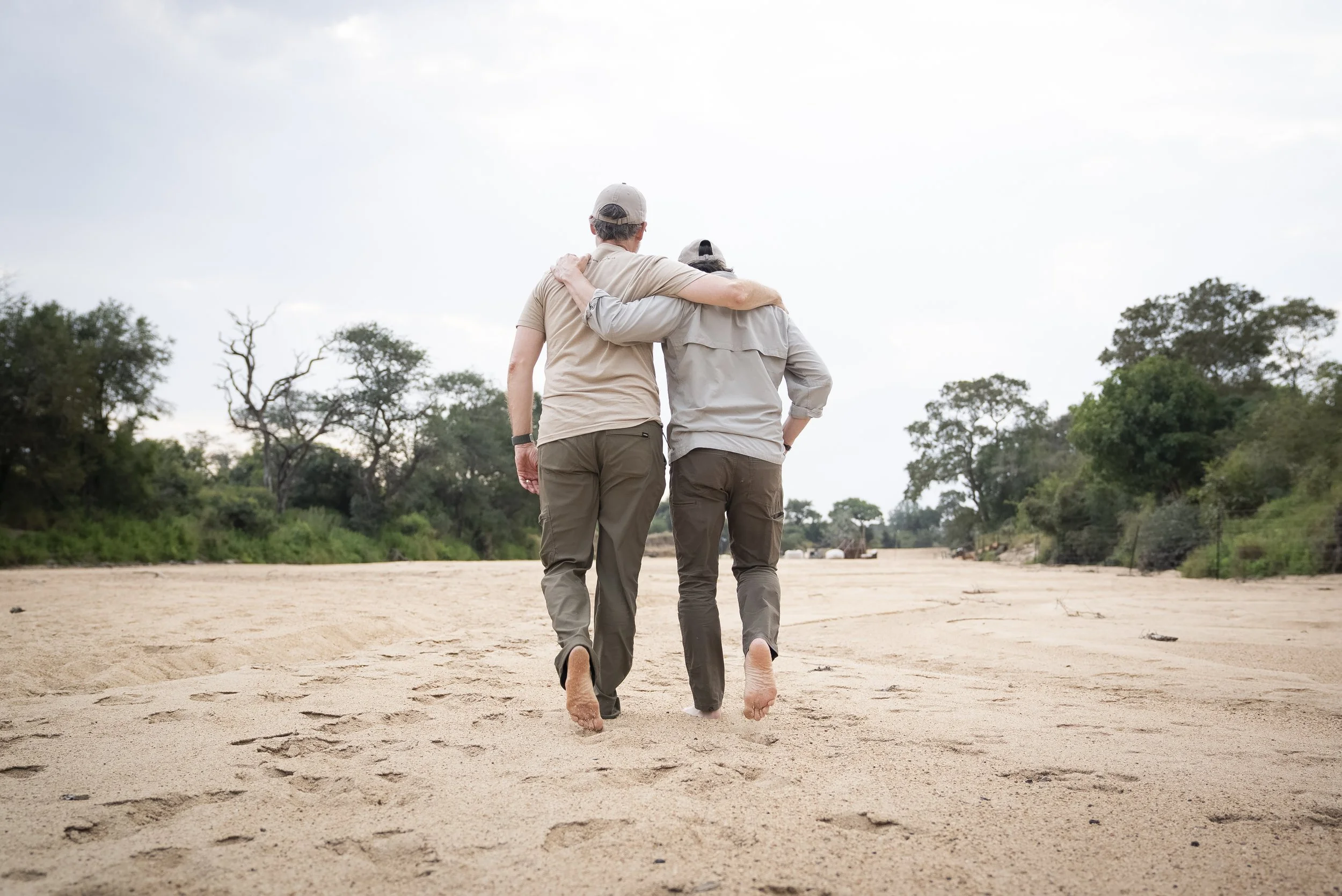
The return. Photo by James Tyrrell
Remember The Fire
We went into the bush thinking we were looking for animals. We returned having recovered something more difficult to name: a deeper attention, a greater respect and empathy toward one another, and a clearer sense of the fire each person is responsible for tending.
When we’re in the bush, we gather around the fire each morning and evening for connection and reflection. It’s an important metaphor and anchoring point of the whole experience, especially for founders who have used the power of stories to create something from nothing and rally others to follow their dream. Fire is a central force that has gathered humans and their stories together throughout our history.
On the first day, before crossing the threshold, I shared a poem that had popped out in my journal during a rare moment of solitude, just a few minutes before, while preparing to welcome the group. I read it again on our final evening during a closing ceremony around the fire after everyone had shared their reflections and inspired insights from our experience together. It felt like the perfect closing send-off, especially for entrepreneurs facing the return and integration phases of the rite of passage that inevitably accompany their return to the known world.
Remember the fire.
Remember where it lives
The warmth it brings
Drawing in those who need to borrow the flame
Blown out by a hurricane
Or forgotten as a distracting call seduced them away into the dark.
Tend your fire.
Light it up each morning.
Light it up with sunrises.
Light it up with cold water.
Light it with a pen,
Or walking,
Or listening to birds,
Or standing on the grass with bare feet.
You must move.
You must move into uncertainty.
Don’t be afraid of friction.
You must rub two sticks together to create fire.
You must allow yourself to burn a little.
And then,
Only then can you see
You’re the container for the fire.
You’re the container
For the intricate light show of chemical reactions
Cascading inside of you,
Invisible,
Animating your breath, digesting your food, and moving your feet
In an infinite loop of circulating fire.
You are on fire
And it’s up to you to transform it
Into the beautiful vision
Burning in your mind’s eye
A vision that no one else can see,
Give you, or create for you.
You must transform this fire
Into the one thing
Only you can see.
And then you must let go,
Fall back into the unknown,
And give it all
All of your fire
You must give it away.
To receive more articles like this in your inbox, sign up for the Founders Edge newsletter below.
To apply for the next Soul Tracking retreat for founders in 2027, visit www.foundersoasis.life